The conversation about AI and education has never been louder. What's harder to find is clarity about what's actually happening in schools and systems and what it would take to get this right for kids who can't afford for us to get it wrong.
Last week, I moderated a panel at SXSW EDU called "Early Days Again: What AI Makes Possible for New Schools," with Frances Messano from NewSchools Venture Fund, Adeel Khan from MagicSchool AI, and Neerav Kingsland from Anthropic (and former City Fund managing partner and current board member).
The conversation kept returning to a gap that doesn't get enough attention: most people assume AI is already central to how new schools teach and operate. The honest answer from people closest to school design is that it mostly isn't. At least not yet.
Most schools are using AI for back-office efficiency. Adeel has pushed further than most through MagicSchool, putting AI directly in teachers' hands for lesson planning and feedback. Frances, who works with school founders, was direct: AI isn't yet showing up in how new schools are designed from the ground up. And Neerav framed the technology trajectory clearly — the tools are moving faster than most school systems are prepared for. That gap, and what it would take to close it deliberately, is what this moment is really about.
A new brief from NewSchools Venture Fund, Educator Roles in the Age of AI, puts it plainly: AI adoption in K-12 education remains incremental, even as other sectors experience rapid transformation. The field currently lacks shared language, frameworks, and learning structures to guide responsible experimentation. As John Bailey, a senior fellow at the American Enterprise Institute, recently told Jessica Baghian of Watershed Advisors, leaders who are waiting for someone else to set direction are already falling behind.
Without a coordinated strategy, school systems serving predominantly low-income students will fall behind their wealthier peers.
The data backs that up — in two ways local leaders need to pay attention to.
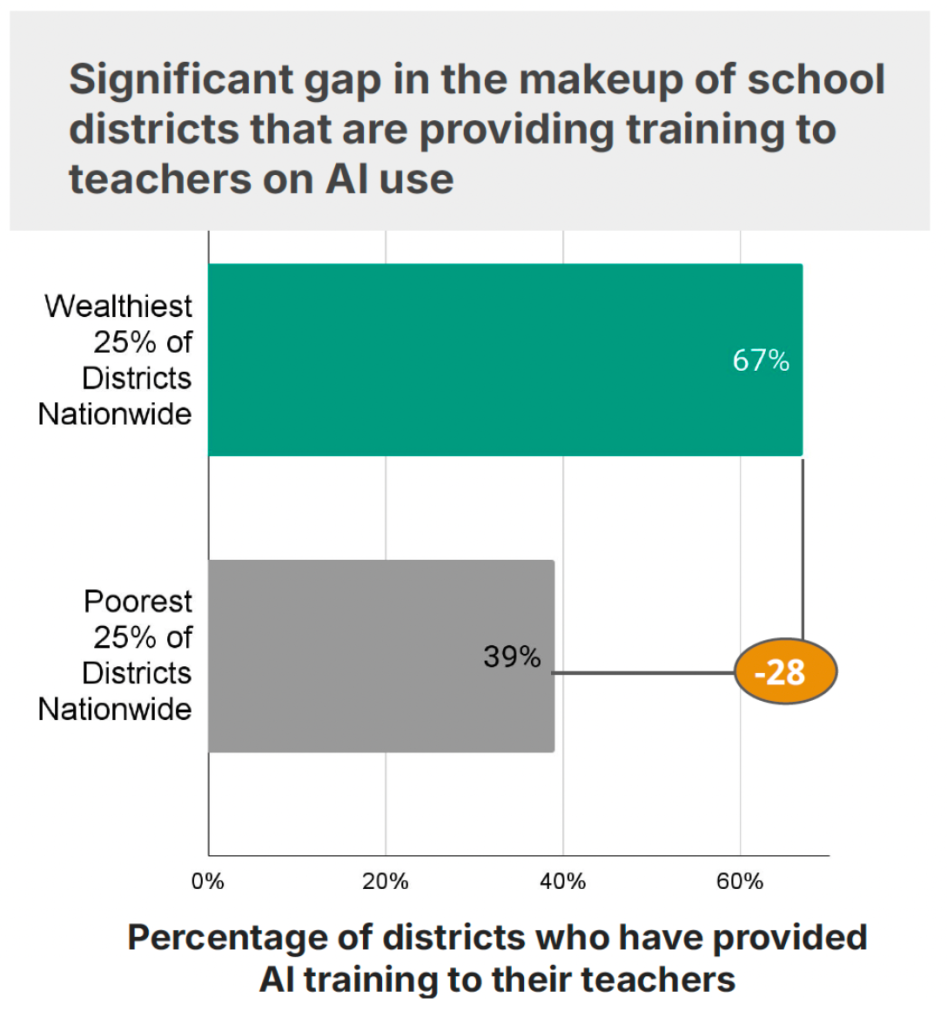
First, on the school side: according to RAND, 67 percent of the wealthiest school districts nationwide have provided AI training to their teachers. Among the poorest districts, that figure drops to 39 percent, a 28-point gap that isn't narrowing on its own. The schools with the most resources are building educator capacity, while the schools that need support the most are largely on their own.
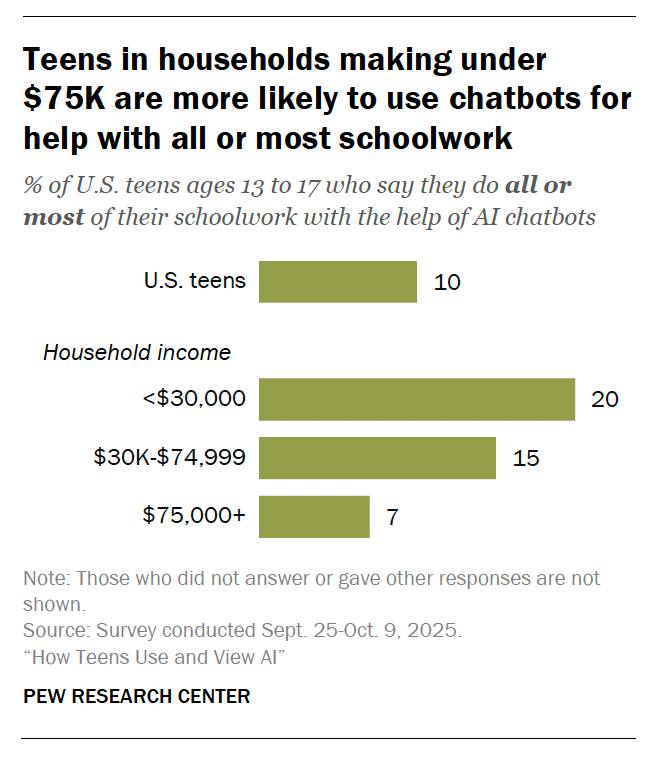
Second, on the student side and this is the part that should give leaders pause. New Pew research is showing that more than half of U.S. teens say they've used chatbots to help with schoolwork. Teens in households earning under $30,000 are nearly three times as likely as their higher-income peers to say they do all or most of their schoolwork help from a chatbot.
The tools are already in students' hands. The question is whether schools are helping them use those tools to deepen their own thinking or just stepping aside while the chatbot thinks for them. Uncommon Schools has done serious work here, building classroom habits that keep the intellectual work with the student rather than outsourcing it to a tool.
That same deliberateness shows up at KIPP New Orleans, where an AP Government teacher at Frederick Douglass High School trained an AI tool on the existing curriculum and grading rubrics to provide students with personalized writing feedback within 24 hours. The spring pilot produced the highest AP Gov passing rate in school history.
Following the success of the pilot program, 225 teachers started grading some assignments with EnlightenAI. A total of 51,000 student submissions have been graded–freeing up between 4,000 and 8,000 hours of educator time for one-on-one student support.
The New Orleans AI Education Fund, with funding support from New Schools for New Orleans, Booth-Bricker Fund, and the Rosenthal Family Foundation, has approached the city's challenge with unusual deliberateness. Eight CMOs serving roughly 60 percent of New Orleans students are in cohort-based development — learning together and building organizational capacity before scaling.
New Orleans isn't the only place building this kind of momentum. In San Antonio, City Education Partners has been creating structured space for educators to engage with what AI actually means for their classrooms. Later this month, City Education Partners will partner with Teach For America San Antonio to convene educators from across the city for a hands-on professional learning experience grounded in Ethan Mollick's Co-Intelligence: Living and Working with AI.
New Orleans and San Antonio point to the same lesson. What makes this work is local leaders who bring people together — educators, CMOs, partners — and create the conditions for shared learning before asking anyone to go it alone. That kind of citywide coordination is exactly what this moment requires.