Seven years ago, I joined a small team to help launch City Fund. We started with 8 cities and were driven by a singular belief—that not just single schools, but entire school systems could dramatically improve.
The results in New Orleans, Washington, D.C., and Denver gave us reason to believe this was possible. Over a decade of work, countless educators and leaders in these cities built fundamentally better schools for students, and we believed we could help the next wave of cities learn from these cities as they create their own paths. We were clear-eyed that this would take time, and it would not be easy.
Today, we’re working with local leaders in 23 cities. We’ve learned a lot–from the progress these cities have made and from the very real challenges they’ve faced. We want to share -- now and going forward -- what we’re learning. Both to spotlight the work of remarkable leaders and to help others who might also want to take on this work in their communities.
The context for this work has been far more tumultuous than we could have imagined. Around the time of our founding, the bipartisan education reform coalition cracked after a series of “red wave” protests and teacher strikes. COVID brought unprecedented learning loss, chronic absenteeism, and staffing crises. Political winds changed around school choice, with post-pandemic parent demand driving rapid expansion of education savings accounts.
At the same time, other major shifts were underway in schools, including the widespread adoption of the science of reading and high-dosage tutoring programs, and the arrival of generative AI with its potential to upend…everything.
In the face of all this, it would be understandable if the local education leaders we support went into survival mode. But that's not who these leaders are. They didn't sign up to manage decline or wait out disruption—they’re in this to transform outcomes for kids.
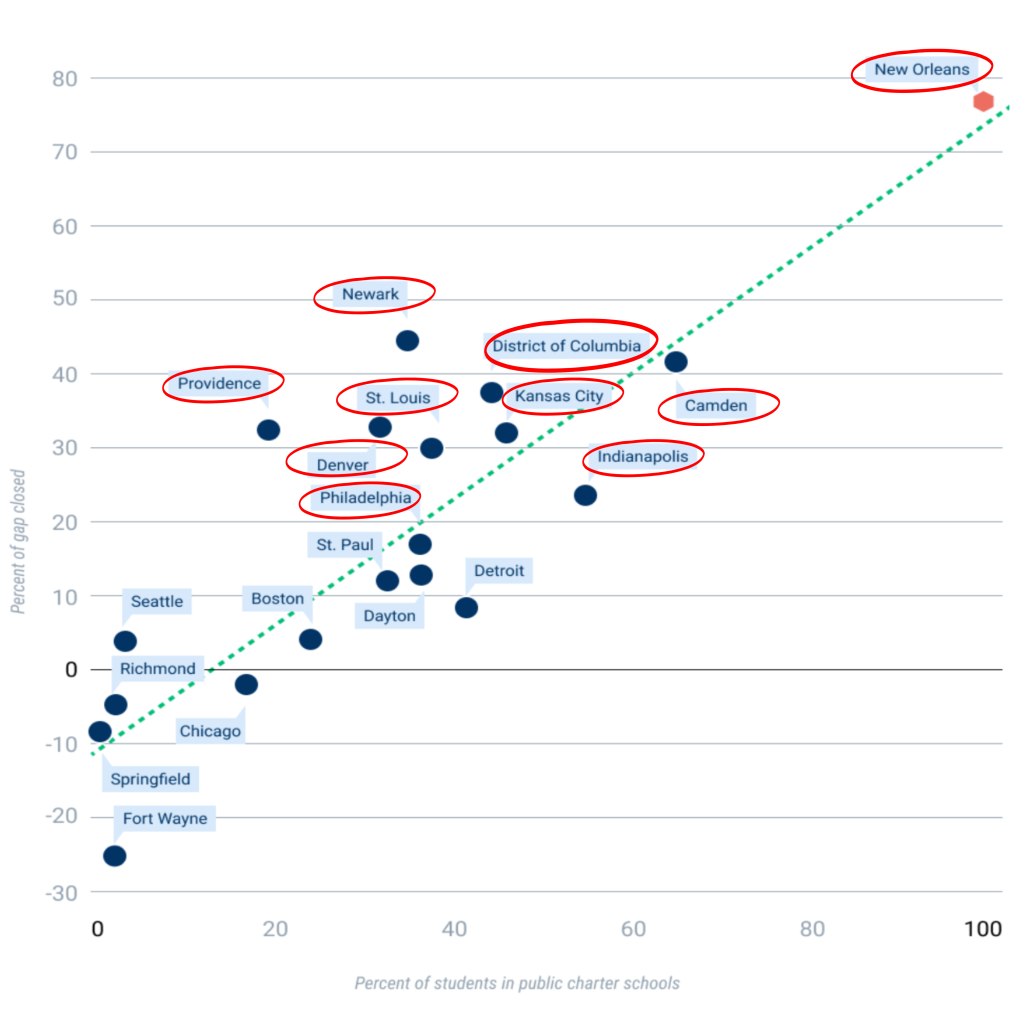
And they've done exactly that. Cities that have taken on the hard work of growing high-quality charter schools are making meaningful progress in closing the performance gap between low-income students and state averages. City Fund now supports all nine cities with the strongest citywide academic results in the Progressive Policy Institute's recent study, Searching for the Tipping Point.
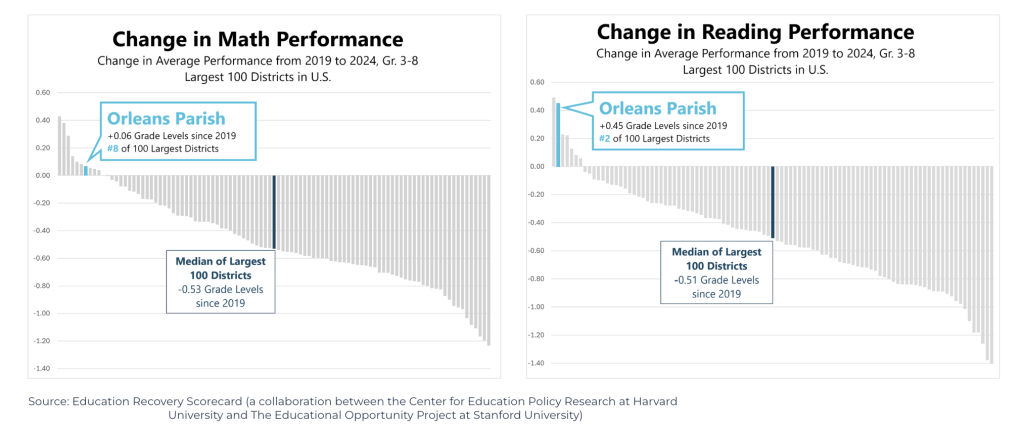
New Orleans continues to light the way forward. This fall, 20 years after Hurricane Katrina's devastation, the city earned its first-ever "B" rating. Tom Kane and the Education Recovery Project at Harvard have been tracking academic recovery post-COVID for the top 100 large districts in America. New Orleans students ranked #2 in reading and #8 in math.
New Orleans has become a national leader in academic recovery following the COVID-19 pandemic
Education is hard and complicated, but it can also be simple. For twenty years, New Orleans has achieved impact by doing the simplest thing: grow what's working, stop doing what's not.
When you combine that work with systems that empower families to find the right school and ensure all schools serve all students, the citywide results speak for themselves.
For the next set of cities to learn from these successes and drive their own progress for students, they'll need to navigate a whole series of new challenges. Two of the biggest ones that we’re tracking today are around school supply and enrollment trends.
Shifting School Supply
A decade ago, most new schools came from large national charter management organizations with twenty-year track records of delivering outstanding results for low-income students. Post-COVID, many of these CMOs have rightfully focused on academic recovery rather than expansion.
There is now new energy emerging around smaller local charter schools—growing from one school to two, two to four—and innovative leaders launching new models like the Tennessee Nature Academy or Nurses Middle College High School in Nashville. This growth brings fresh ideas when we need them most, but also challenges: how do we ensure these schools can deliver on their promise without the benefits of the economies of scale that larger CMOs enjoy?
To be successful, cities must harness both—helping strong CMOs continue growing while supporting innovative new leaders pushing boundaries on what's possible.
Enrollment and Demographic Change
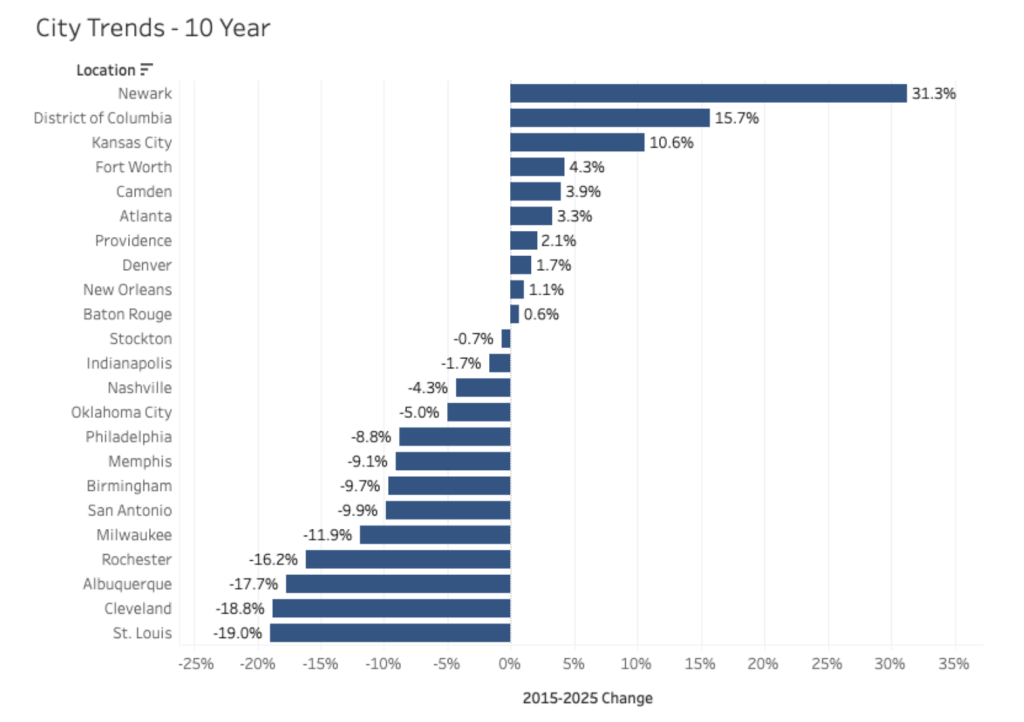
It’s no secret that our K-12 education system is experiencing a significant enrollment decline. Public school enrollment fell by 1.3 million students (to 49.5 million) between 2019 and 2023, driven by declining birth rates and accelerated by COVID. Homeschooling increased, private school enrollment grew 22%, and newly expanded choice programs in 16 states are drawing more families—participation grew 25% last year alone. Public school enrollment will continue to fall.
Yet the city-level picture is complex. Charter enrollment has grown steadily in 95% of the cities we work with, despite overall declines. Parents clearly still seek out quality public school options. But cities face different strategic implications: those with growing enrollment struggle to find facilities for high-performing schools to expand where they are needed most, while cities with declining enrollment must thoughtfully consolidate or merge schools to preserve quality programming and resources.
Overall Public Enrollment Trends (10-Year % Change*)
These new tensions are real, but they don't change the fundamental truth that when cities commit to growing quality schools and empowering families with choices, students benefit.
What drives our optimism is the track record of the local leaders we support. Seven years ago, we invested in the idea that the people who know their communities, understand their contexts, and wake up every day focused on their cities' children could drive systemic change.
As my colleague Patrick Dobard wrote in an op-ed this month for NOLA.com: “Accountability systems and political priorities change, but the principles that got us here — equity, autonomy and collaboration — are not up for negotiation.”
Overwhelming evidence has validated that early conviction. In Indianapolis, Camden, Kansas City, D.C., and beyond, these leaders haven't just weathered unprecedented challenges—they've delivered results while navigating political shifts, pandemic recovery, and changing demographics. They've proven that sustainable education improvement comes from visionary local leaders with the support to do what they know works for their communities.
We're proud to support these leaders. We're committed to tracking their progress, connecting them to learn from each other, and sharing what works with the broader field. Because when one city figures out how to grow great schools in this new landscape, every city should benefit from that knowledge.